Saturday, September 30, 2006

Feast of Feist


Ok, now a personal rave about a musician who is QUITE UNdisintegrating and has actually made this particular KNOCK-OUT punch In One Round (cause for seein' stars, angels, boi-oi-oingin bedsprings, bells, and tweety birds circlin around the head of the floored-in-the-best-sense-of-the-word listener) record in 2004 and is still touring under the snowballing rep from it.

I'm talking about Let It Die by the chanteuse canadienne Feist otherwise known as Leslie Feist. Feist, now living in Paris, is accompanied by her musical partner, Chilly Gonzales, a veritable WIZARD of restrained electronica and together they serve up something rare. The record evidences how much can be done with the deft placement of a DJ style record scratch, or acoustic guitar juxtaposed with claps, and simple keyboard grooves that shift in shape and tone - all seducing the ear with surprise. When you find yourself at the end of the record you've been guided by a voices and whispers through a house of colored rooms accessible through sliding doors, staircases that disappear behind you, liquid mirrors, and hidden locks. You're out the back door into long grass of the yard, giving the dog a pet and ready to head back in the front door and do it all over.
This is one of those records I play in the car and then circle around the neighborhood - at a suspicious, curtain-lifting 10 miles an hour - because I don't want to get home quite yet...

Every song is an unpredictable variation of Folk-Pop-Trip-hop-R&B originals and re-workings - if you need to nail it with a label. Despite the forbidding title, Let It Die is largely a euphoric feast but no piece of fluff emotionally.
Feist has a gorgeous voice and delivery that has drawn a slew of comparisons but my first take on it was a taste of Dusty Springfield. In past musical configurations Leslie was heavy on the screaming and 'threw out' her voice. During her sabbatical from singing she practiced guitar and slowly worked her way back into - well, fuhchrissakes, you really gotta check it out!

* i like this live clip of her singing Secret Heart on youtube
FeistSecretHeart

Thursday, September 21, 2006

I'm Only Sleeping


- charcoal/watercolor by Henri Matisse

"When I wake up early in the morning,
Lift my head, I'm still yawning
When I'm in the middle of a dream
Stay in bed, float up stream ......"

Up for auction at Christies a year ago, were some scribbled lines in blue felt pen on the back of a car "radio-phone" bill sent to John Lennon by the post office in April of 1966. They were to become the lyrics for "I'm Only Sleeping", a mysterious wisp of a tune which, a week or so later, commenced recording on the UK version of Revolver.

That song has always stood apart, off the beaten road, in the unmapped place. It captures that twilight sliver just between sleep and waking where the dreamer KNOWS he's dreaming and doesn't give a hang about the pressing issues of the waking world.
The only other song that Lennon wrote that gives me a similar feeling is "Julia" - not, as some might expect, "Strawberry Fields", which is really a different alteration of mind-place altogether.

In my head, the lyrics of "Julia" and "Sleeping" meet and blur as one:
"Her hair of floating sky is shimmering, glimmering,
In the sun" and
"Keeping an eye on the world going by my window
Taking my time"
become that place where the shadows of clouds on a rainy day flicker against a storefront window or puddle in the street - again, the omnibus-shuttle service between waking and dreaming.

When mentioned at all, "I'm Only Sleeping" is referred to as the song where "the backward guitar' of George Harrison makes it's debut. In the fascinating memoir of Beatle sessions by participating sound man Geoff Emerick, "Here, There, and Everywhere", much is made of the exasperatingly long time spent by Harrison getting mere 4 bars or so of guitar just right. Apparently George composed a melody, had it recorded backwards, and then learned it in its backwards form to be played "straight" on the recording. Hard to believe it's "live" in the recording but my hat's off to George for carrying it off. Any artist knows that the absorption in a creative conception, obliterates time (or sleeping, eating, and paying the phone bill as well), so 14 hrs for 20 or 30 seconds of recording is a trifle. Paul too, was caught up in the the backwards guitar bit and the resulting "duet" with George at the end of "Sleeping" is a gem - a bouquet of sonic nerve-end tendrils that suggests bagpipes, hurdy-gurdies or the South Indian shehnai.

Strangely enough for the Beatles, this song always seems on the verge of, or down-right dipped into, the realm of jazz. Paul's walking bassline (with passing tones!)and John's melody give it the lilt of swing. I spent a long walk thinking of an ideal "put-together" jazz quartet to do the song justice - with as little "alteration" as possible; no diminution of the melody by bullshit jazz cliches, just cool and crisp blowing with a sense of breathing space. I'd have Miles Davis circa 1954 on muted trumpet (ala Solar or If I Were A bell) - or maybe Tony Fruscella on straight trumpet - then Jimmy Jones on piano (Sarah Vaughn's brilliant accompaniment for many years) and a straight-forward but swinging rhythm section; Percy Heath on bass and Conny Kay on drums.


"Please don't wake me, no
don't shake me
Leave me where I am
I'm only sleeping

Everybody seems to think I'm lazy
I don't mind, I think they're crazy
Running everywhere at such a speed
Till they find, there's no need

Please don't spoil my day
I'm miles away
And after all
I'm only sleeping

Keeping an eye on the world going by my window
Taking my time

Lying there and staring at the ceiling
Waiting for a sleepy feeling

Please don't spoil my day
I'm miles away
And after all
I'm only sleeping

Keeping an eye on the world going by my window
Taking my time

When I wake up early in the morning,
Lift my head, I'm still yawning
When I'm in the middle of a dream
Stay in bed, float up stream

Please don't wake me, no
don't shake me
Leave me where I am
I'm only sleeping"


- John and music critic Ralph Gleason in 1966

*thanks to Jimmy and Steve for mention of Geoff Emerick's "Here There and Everywhere"
- also of interest to UK "Revolver" fans:
"Every Sound There Is" edited by Russell Reising - a compilation of writings about the "Revolver" sessions.

Monday, September 18, 2006

Sky of Orange Whispers


HALF NOTE


since poetry is the only nightclub
where anything can happen
let's take a look at it

if you go to the right you're wrong
if you go left you're incorrect
if you go straight you're a fool

poetry is a swimming pool

no it's a diving board
this drink is so good I could dive right into it

you've got to avoid
......................the ice cube

- Howard Hart from "The Sky of Orange Whispers"

mr. hart
jazz drummer
mentored by kenny clarke
left for paris in '46 and met django
who asked him to audition but howard let it slip as
he found baudelaire's flowers of evil at a kiosk by the seine and wasted the hours
in epiphany then and there poetry was as important to him as music
returned to nyc in 47 studied composition with mills and bernstein
hung with charlie parker and delmore schwartz
roomed with and read alongside kerouac and lamantia
wrote plays
wrote poems
blew some wigs
shuttled twixt coasts
between arts
passed through worlds in 2002
over to the other side

Howard Hart wrote poems of unusual subtlety and color and I'm having trouble putting down
"The Sky of Orange Whispers" which is in a slender pocket-size volume that i take everywhere
check www.emptymirrorbooks.com
amazon.com and your local inter-library loan to get hold of his others

Sunday, September 17, 2006

Jazzpoets at Blue O'Clock


late in the game photo of poets Howard Hart and Bob Kaufman in the basement of City Lights Bookstore circa 1980

Howard Hart and Bob Kaufman were the among last unsung poets influenced by jazz idiom and cadence. They were contemporary with the likes of Jack Kerouac and Ted Joans back in the 50's and migrated from New York to longtime residency on the "Left Coast", North Beach, San Francisco.

Bob Kaufman, in particular, was steeped beyond the others in the sound of jazz. "Crootey Songo" featured "meaningless" words created as one would blow a jazz solo over a rhythm section; not the "oobie-doobie la wah doo-bah" of scat singers but more along the lines of;

DEEREDITION, BOOMEDITION, SQUOM, SQUOM, SQUOM.
DEE BEETSTRAWIST, WAPAGO, LOCOEST, LOCORO, LO.
VOOMETEYEREEPETIOP, BOP, BOP, BOP, WHIPOLAT.

However most of his poems were accessible and spoke immediately to the listener/reader;

SLIGHT ALTERATIONS

I climb a red thread
To an unseen existence
Broken free, somewhere,
Beyond the belts.

Ticks have abandoned
My astonished time.
The air littered
with demolished hours.

Presence abolished
I become a ray
From the sun
Anonymous finger
Deflected into hungry windows
Boomerang of curved light
Ricocheted off dark walls
The ceiling remembers my face
The floor is a palate of surprise
Watching me eat the calendar

(from a Kaufman compilation called "Golden Sardine" supposedly found on brown wrapping paper rolled up and found in his room)

Kaufman was born in New Orleans of mixed heritage. Touring the world as a merchant seaman he ended up in NYC and then San Francisco where he became a mainstay on the North Beach poetry scene. Styling himself a Buddhist and incapable of self-promotion, he
performed his poetry from memory and only reluctantly, on his wife's insistence, wrote anything down. His most famous haunt was the Co-Existence Bagel Shop on Grant Street where devotees would flock in the hopes he would show for an extemporaneous "reading".
He became more reclusive as the 60's ended; taking a vow of silence during the War - although friends would point out, with some levity, that he would break it occasionally to ask "Got any speed?"
Worn down and ailing from years of drug addiction, police confrontation, and shock therapy, Bob passed away in San Francisco Jan 12, 1986.

Though he was published by New Directions and City Lights, respected and held in awe by his peers, "the hidden master of the beats" never quite fit in to the beat movement or any any movement - an individual to the last;

'...i know of a place in between between, behind behind, in front of front, below below, above above, inside inside, outside outside, close to close, far from far, much farther than far, much closer than close, another side of an other side...it lies out on the far side of music...that darkling plane of light on the other side of time...it begins at the bitter ends..."


Bob Kaufman in younger days


* thanks to dear pal Sarah of Waterville for sending me some Kaufman just when the soul needed it most!


check out Bob Kaufman's poetry books:
Golden Sardine
Ancient Rain
Solitudes Crowded With Loneliness
Cranial guitar

Friday, September 15, 2006

P-celts and Q-celts


A strange happenstance in the story of European language that continues to fascinate me and 12 other odd souls in the world;
The division of the Celtic Languages into those who will use a "P" sound for the same word that another Celt will use the "Q" (or more modernly expressed hard "C" sound).
So, on the P team we have the Welsh, the Bretons, and in days gone past; the Cornish, Cumbrians, the Gauls (for the most part), the Lepontic Celts (Northern italy) and a few other stragglers. The Picts in Scotland are thought to have spoken a Pre-Celtic language that was later melded with. or superseded by, a P-Celtic dialect
On the Q Team we have the Irish, the Scots, the Manx, and in days gone by; the Celtiberians of Spain - now represented by the Galicians, Asturians, and to some extent, the Portuguese (presently, respectfully, speaking dialects of Spanish and Portuguese influenced by their former Celtic tongues).

as an example;

four and five in Welsh are "pedwar" and "pump"
in Irish they are "ceathair" and "cuig"

son in Welsh is "map"
in Irish it's "mac'

"head" or "headland" in Welsh is "Pen" - thus a large number of place names beginning wwith "Pen"
in Irish it's "Ceann" - ausually anglicized into "Ken" or "Kin" (thus Kenmore and Kintyre, etc.)

.....and so it goes. No one knows for sure how, why, and when the division began.

What is even more interesting is that a similar division occured within the Italic languages (Latin was a "Q" language and the long-gone Oscan-Umbrian languages "P").
The division was also evident between Latin and Greek. Thus prefixes for five derived from Greek use "penta-" (ie. pentagon, pentacle) while Latin uses "quinta-" (think of quintuplets and quincunx).
There is some postulation that the P-Celts on continental Europe lived in areas near the P-group Italics and Hellenics and there was some exchange of language pattern.

We know from Pre-Roman inscriptions that the Celtiberians of Spain spoke a Q-celtic language and this may give credence to the ancient Irish oral tradition that claims a major Celtic settlement via the sea from Northern Spain some 2500 or more years ago. A friend of ours from Galicia is fond in pointing out that her family could easily pass for Irish.

* now, for an almost unrelated diversion; I've heard it said that some scholars claim that "the eeney, meeny, miney, moe" of "catch a tiger by the toe" is derived from the Pre-Celtic language of Britain. Then there is the old language of the tinkers in Ireland and Scotland...

Wednesday, September 06, 2006

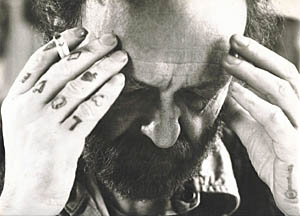
Epistle To Derroll


Epistle To Derroll - Donovan


Come all ye starry starfish
living in the deep blue sea
crawl to me i have proposition to make thee
would you walk the north sea floor
to Belgium from England
Bring me word of a banjo man
With a tattoo on his hand.

The spokesman of the starfish
spoke as spokesman should
"If’n you met our fee then
certainly we would,
If you cast a looking-glass
upon the scallopped sand
You'll have word o' this banjo man
with a tattoo on his hand."

"Come ye starry starfish
I know your ways are caped
maybe its because your astrologically shaped,
Converse with the herring shoals
as I know you can
Bring me word o' the banjo man
with a tattoo on his hand."

The eldest of the starfish
spoke, after a sigh,
"Youthfull as you are young man
you have a 'Wisdom Eye';
Surely you must know a looking-glass
is made from sand?
These youngfish are fooling you
about this banjo man."


"Come then aged starfish
Riddle me no more,
for news I am weary
and my heart is sore;
All on the silent seashore,
help me if you can,
Tell to me if you know
of this banjo man."

"All through the seven oceans
I am a star, most famed,
Many 'leggys' have I lost
and many have I gained,
Strange to say quite recently
I've been to Flemish Land
And if you are courteous
I'll tell you all I can."

"You have my full attention"
I answered him with glee,
His brother stars were twinkling
in the sky above the sea
So I sat there with rapt
attention, on the sand,
very anxious for to hear
of the banjo man.

"I have seen this tattooed hand
through a ship port-hole,
Steaming on the watery main
through the waves so cold,
Heard his tinkling banjo and
his voice so grand
but you must come to Belgium
to shake his tattooed hand."

"Gladly would I come oh
gladly would I go,
Had I not my work to do
and my face to show,
I rejoice to know he's well
but I must go inland,
thank you for the words you brought
of the banjo man."

I walked along the evening sand
as charcoal clouds did shift
revealing the moon shining
on the pebble drift
Contemplating every other word
the starfish said
whistly winds they filled my dreams
in my dreaming bed.


(below, a little about the man behind my favorite Donovan song - off of "For Little Ones" in 1967)

Derroll Adams was one of those peripheral legends whose name was threaded in and out of the music and commentary of some of the musical idols who really turned me around to playing and composing (yes, even in the jazz realm)- notably Bert Jansch, John Renbourn, and Donovan Leitch.
Derroll came over to Britain in the 1950's on tour with his pal Ramblin Jack Elliot -and together they really had an impact on the British folk scene.

Derroll wrote a famous song much covered in the folk world "Portland Town". He had a deep singing voice, a magnetic stage presence, and a simple but original, "up-picking" banjo-style that even guitarists like Donovan and Bert Jansch were drawn to and incorporated into their guitar styles. On his 2nd record, Bert Jansch actually recorded his only solo banjo tune, "900 Miles", which he learned from Derroll.
Derroll remained in Britain throughout the 60's and 'retired' with occasional appearances to Antwerp, Belgium where he lived til his death on Feb 2,2000.

* kind readers -as someone said, Derroll's life reads like a full-length Wallace Stegner novel - and i wouldn't know where to begin to pick up all the bits and pieces.
here are some nice links.

www.wizzjones.com
A must-see video clip of another legend, English guitarist/ singer Wizz Jones singing and playing (with a bit of Derroll's influence on guitar) a tribute to Mr. Adams
a simple and affecting song "The Man with the Banjo"

http://www.theessink.com/en/photos/derroll/derroll01.html
The site of the incredible Belgian blues and roots musician Hans Theessink featuring plenty of great pictures of Derroll Adams. Hans contributes some great renditions to "Banjoman: A tribute to Derroll Adams" which also features Arlo Guthrie, Donovan, Ralph McTell, and even Dolly Parton among other luminaries!

http://corporate.skynet.be/welec/songs.html
discussion and soundclips regarding Derroll's banjo style and songs.

www.derrolladams.com
...is currently under revision; as I remember seeing it many months ago, very impressive.

* special thanks to Hans Theessink for the picture off Derroll and his "tattooed hand" featured above

Sunday, September 03, 2006

Hotel de Lauzun


In the 1840's, the Hotel de Lauzun, on the Ile de St Louis in the heart of Paris, rented out rooms to the Club De Hashiscins. The Hashischins counted among their members some the most respected novelists, painters and poets of Paris of the time.
Theophile Gautier, Victor Hugo, Alexandre Dumas, Gerard de Nerval, Eugene Delacroix were regulars but Gustave Flaubert and Balzac dropped by.
Charles Baudelaire was the most notorious member, although he was not a frequent "paricipant" he rented an apartment in the building and worked on his famous "Artificial Paradises" book which described (more from observation and conversations with the "Club" members than his own experience) the effects of hashish intoxication.

Gautier recounts his initial experience at the Hotel:

"One December evening..I arrived in a remote quarter in the middle of Paris, a kind of solitary oasis which the river encircles in its arms on both sides as though to defend it against the encroachments of civilisation. It was an old house on the Isle the Ile De St.Louis the Pimodan hotel built by Lauzun..."
Gautier comes to room where, "several human shapes were stirring about a table, and as soon as the light reached me and I was recognised, a vigorous shout shook the sonorous depths of the ancient edifice. 'It's he! It's he!' cried some voices together; 'let's give him his due!' "
In their rooms at the hotel, the "Club" would don Arab clothing. Before dinner they would drink a strong coffee laced with hashish. Called 'dawamesk" by the Arabs, this concoction, featured a mixture of hashish, cinnamon, cloves, nutmeg, pistachio, sugar, orange juice, butter and cantharides. Hash smokers must take note that in this "paste" form the drug was far more potent.

"The doctor (Jean-Jacques Moreau, a founding member)stood by a buffet on which lay a platter filled with small Japanese saucers. He spooned a morsel of paste or greenish jam about as large as a thumb from a crystal vase, and placed it next to the silver spoon on each saucer. The doctor's face radiated enthusiasm; his eyes glittered, his purple cheeks were aglow, the veins in his temples stood out strongly, and he breathed heavily through dilated nostrils. 'This will be deducted from your share in Paradise,' he said as he handed me my portion..."
Dinner follows and then the hashish begins to take effect. Gautier notices the others appear "somewhat strange. Their pupils became big as a screech owl's; their noses stretched into elongated probosces; their mouths expanded like bell bottoms. Faces were shaded in supernatural light....a deadening warmth pervaded my limbs, and dementia, like a wave which breaks foaming on to a rock, then withdraws to break again, invaded and left my brain, finally enveloping it altogether. That strange visitor, hallucination, had come to dwell within me."
What then transpires in each of the participant would depend on whom one asks...

Baudelaire introduces his comments in Les Paradises Artificiel by what now appears to be common knowledge, that the hasheesh eater "
will find in hashish nothing miraculous, absolutely nothing but an exaggeration of the natural. The brain and organism on which hashish operates will produce only the normal phenomena peculiar to that individual - increased, admittedly, in number and force, but always faithful to the original."
Baudelaire's personal experience was fascinating and otherworldly but ultimately nightmarish, as if he had been reading nothing but Poe for a decade.
Balzac, who claimed to have heard celestial voices and beheld divine paintings remained a loyal unadulterated coffee-fiend: he was known to drink 20 or more cups a day.
Gautier's love affair with the drug was short-lived, and he quit "after trying it some ten times or so,... not that it hurt me physically, but because a real writer needs no other than his own natural dreams, and does not care to have his thought controlled by the influence of any agency whatever."
Amen to that!

..and yet, wouldn't I like to venture down to the local time-travel rental on a foggy evening, tear out of the 21st century lot, and make my way (my vehicle now transformed to a horse and carriage), down the avenue Quai d'Anjou to number 7, the Hotel de Lauzun, adjusting my fez as I wend up the staircase and take a corner chair in the dark? Sipping on strong coffee, of course...

* thanks to the ever-eloquent persephone2u for reacqainting me with Baudelaire and De Quincey.

Saturday, August 26, 2006

William Carlos Williams; Song


beauty is a shell
from the sea
where she rules triumphant
till love has had its way with her

scallops and
lion's paws
sculptured to the
tune of retreating waves

undying accents
repeated till
the ear and the eye lie
down together in the same bed

Serge Chaloff: Body & Soul, April 4, 1955


The standard ballad “Body and Soul” has long been a common musical podium where jazz improvisers step up to make their own signature testament – not necessarily with that intent, but certainly with an awareness of the different takes on it that have come before.

My personal favorite is baritone saxophonist Serge Chaloff’s version from his “Boston Blow Up” record. As I see it, Hawkins, Rollins, Coltrane and the rest need to step aside for this one.

Chaloff’s statement; alternatively tender, raw and harrowing – like someone suddenly overcome with memories of a love affair long put aside in the interest of “carrying on”.
Serge stood apart from other baritonists (ie. Mulligan, Pepper Adams, Cecil Payne etc.) in that he consistently chose to play the full range of the instrument high to low. The varying textures in different registers give drama to the change in dynamics and emotion in his “story line”.
There are times when he moves too suddenly from a gentle line to a harsh, blasted note. Having heard this version a thousand times over 30 odd years, I now anticipate it and prepare myself, but in the totality of the song it makes perfect sense – it almost breaks from “music” and becomes a voiced, unpremeditated confession.

Serge tops off his masterpiece, ending the with a short a cappella cadenza: he descends deftly down a stony stairway after having made his statement on the windy heights and jumps headlong into the bottom Bb – disappearing into a jazz eternal night, leaving naught but the ripples.
(did I just say that?)

* 2 landmark records of Serge have been released in one cd package by Definitive records out of Spain: his masterpiece, Blue Serge – with Sonny Clark, Philly Joe Jones, and Leroy Vinnegar; together with Boston Blow Up (with a stellar cast of Boston bebop players of the time), not as great in its totality but worth it just for Body and Soul

Friday, August 18, 2006

Three Nines for Mr. H.


Nine Liverpool Streets


Fearnside
Fazakerley
Lapwing Court

Ash Crescent
Combermere
Rymers Green

Pimbley Grove
Penny Lane
Bootle


Nine Emanations of Favorite Byrds Tune


She
She Don’t
She Don’t Care
She Don’t Care About
She Don’t Care About Time
.......Don't Care About Time
................Care About Time
........................About Time
..................................Time


Nine North Carolina Rivers


Swannanoa
Hominy Cree
Nolichucky

Nantahala
Great Pee Dee
Roanoke

Shalotte
Roaring
French Broad


* pictured above; liverpool ladies cleaning doorsteps, 1954
and graffiti from Bologna, Italy - photo by Aly Artusio-Glimpse

Thursday, August 17, 2006

If I Could Only Remember My Name


An apt-titled record if there ever was one...but not only in the,"If you remember the 60's you weren't there" sense you might think.
The solo album of David Crosby from 1970-71 still cycles round to my playing lists after lengthy sojourns, like a long-lost friend who travels the world. No amount of obligatory prattle about Crosby's personal-life excesses will budge me an iota from marvel at his musical accomplishments here. In homage to Crosby, who just had a 65th birthday a few days ago, I recall the aphorism of some grizzled Indian seer, "What cares the lion about the croaking of frogs?"

The review of the record by a fan like Scotty Ryan leaves me laughing but eloquently strikes a chord;

"If every speck of weed were to disappear from the planet tomorrow, it would still be possible to get stoned just from this CD. (Strictly speaking, you wouldn't even have to listen to it; you could pick up a contact high just from holding it in your hand.)"
and....
"If the first thirty seconds of "Tamalpais High (At About Three) doesn't leave you stunned and transfixed, then you and I aren't from the same home planet -- and I don't especially want to visit yours."
Now, I might tarry a little longer on some of these planets than Scotty but...
In the spirit of the proceedings I might add, taking first a swig from my own poteen, "In the last 30 seconds of 'Song Without Words' the Guitars of Garcia, Kaukonen, Crosby, and Casady, gently collide and collapse into harmonic shards...there is a silent pause and then the
acapella voices of "Orleans" knead the already realigned cranium into starry-eyed humility. If this doesn't move you, I'll be the first to put a dollar in the jar for your soul transplant."

The record was produced by Stephen Barncard at Wally Heider Studios in San Francisco, while he was simultaneously working "American Beauty" with the Dead. Barncard still speaks with amazement at the focus and inspiration of Crosby at these sessions, but his own contribution - free of the later over-kill of 70's rock/pop records - really makes for a sonic milestone.
"If I Only..." has a cast of thousands of Cosby's musician friends, but the steady- core group that really gives the record its character consists of Crosby on guitars and vocals (sometimes harmonizing with himself), Garcia on lead guitar and pedal steel, Lesh on bass, and Kreutzmann on drums (all from the Grateful Dead), with the addition of Jorma Kaukonen sharing the leads with Jerry, and, also from the soon to dissolve Airplane, the great Jack Casady on bass.
The stellar cast doesn't crowd and jostle the proceedings, which are far more intimate and elegant than the works of their "home" bands. What I would've given to see this ensemble make a few more records.

Master-touches of the session:
Garcia's understated but majestic pedal steel solo on "Laughing" - enhanced seamlessly by Barncard's sound chamber.

The harp and (?) dulcimer of Laurie Allan weaving around Crosby's vocals and guitar on "Traction in the Rain"

The chordal vocal harmonies of Crosby and occasionally Nash on "Tamalpais High", "Song Without Words", the title track at the end, and "Orleans" - the borrowed french folk-song melody sung in french - which turns out to be a mere list of cathedrals....(some residual memory of the Byrds and "Bells of Rhymney"?)

The idosyncratic guitar tuning that Crosby uses on "Tamalpais.." and "Song.." - EBDGAD - the same which lent uneathly beauty to "Guinnevere" on the 1st CSNY session.

Last but not least, Crosby's use of silence to great effect. An oft-forgotten musical
element.


* thanks to Scotty for his kind permission to use his quotes

Monday, August 14, 2006

Jean Dufy


Back in the wayback I hardly gave a wink at Raoul Dufy's paintings. I'd take a peripheral glance and decide that they were just naive, superficial cottony fluff that must have dashed off his brush while he was mincing about in his pajamas and munching on a pink ice cream bon-bon.

Some time later, in the early 80's I saw quirky movie shot in black and white with some surrealistic premise. Now I don't remember the name of it but I do recall Bill Murray had a cameo role as a bus driver who(don't ask me how) took tourists on a jaunt to the moon. One of the main characters was a young artist who was obsessed with Raoul Dufy. Somehow this got me round to looking a little closer at Dufy's work and i wasn't displeased. But, I didn't pursue it further.
(By the way, if anyone out there has seen this movie and knows the name, I'd be grateful if you'd let me know because I've scoured cinephile brains in vain)

Then about 4 years ago I saw a major collection of diverse painters at the Phoenix Art Museum - when I came into the room with the large Raoul Dufy painting of his studio, I was transfixed and had to continually return and bathe in the holy light of it.
Then and there he finally reached me - the lines and colors were so simple but filled with grace and light like a breeze from another planet.

So what does Jean Dufy have to do with it? Well, I kind of blundered across some of Jean's paintings while looking through a catalog of Raoul's. Of course Jean was a younger brother of Raoul and he revered him as a master teacher - among others - and, at first glance there is little to distinguish Jean's paintings from Raoul's. After awhile, a subtle difference can be seen.
Interestingly, though Raoul's paintings were often musically inspired Jean actually was a musician; he played classical guitar and jazz bass.

So in honor, of guitarists, jazz bassists, painters, and - perhaps - lovers of pink ice cream bon-bons, I dedicate this blog to the littler-known Jean Dufy.

Jean and one of his paintings above....

Sunday, August 13, 2006

La Vie En Rose


Edith Piaf's La Vie En Rose is a song that has been popular long enough, far and wide enough, to be a cliche and fodder for amusing parody, while retaining the soul to still sneak up, unsuspected, at just the right moment and pierce the heart.
For the French who lived through the German Occupation Edith Piaf songs have a special emotional pull because of her efforts to help the Resistance and prisoners of war.
Edith Piaf was essentially a child of the streets, rising up from a near homeless existence, singing as a sideshow to her sidewalk-acrobat father. She managed to educate herself, reading on the fly, amid a torrid, mixed-up life. When she died in 1963 "her funeral procession drew hundreds of thousands of mourners onto the streets of Paris and the ceremony at the cemetery was jammed with more than forty thousand fans. Charles Aznavour recalled that Piaf's funeral procession was the only time, since the end of World War II, that Parisian traffic came to a complete stop."
So it is doubly affecting to note that, basically, she herself came up with the melody and lyrics.

Many Americans have only heard the English version of the lyrics, as sung by Louis Armstrong and others:
"Hold me close and hold me fast
The magic spell you cast
This is la vie en rose...." and so on
Actually the original lyrics are quite different, though similar in sentiment.
Here is the begiining of the French/Piaf version - the intro in the first paragraph and the familar melody beginning with "Quand.."- and a very literal English translation after:


Des yeux qui font baisser les miens
Un rire qui se perd sur sa bouche
Voilà le portrait sans retouches
De l'homme auquel j'appartiens

Quand il me prend dans ses bras
Il me parle tout bas
Je vois la vie en rose
Il me dit des mots d'amour
Des mots de tous les jours
Et ça m'fait quelque chose


The eyes that make mine lower
A laughter that gets lost on his mouth
There is the portrait unretouched
Of the man I belong to

When he takes me in his arms
He speaks to me low
I see life in pink
He tells me words of love
The every day words
And that made me something


* at the top, Raoul Dufy's painting "La vie En Rose"

Thursday, August 10, 2006

Orvieto: Slow City


We came to the Italian hill town/city of Orvieto in western Umbria on our jaunt to the coast. It was one of the "unscheduled" delights of the trip - winding medieval streets with walls bedecked with flowers, shops, bars, bookstores, restaurants, young people dressed in everything from solid colors, punkish, scarved, or neo-hippie threads all in an an unassumingly elegant styl, (sprezzatura, again);everywhere friendly laid-back people, patient with my earnest but creaky italian, who went out of their way to guide and give directions.
Beneath the city, dating from Etruscan times, lies a "subterranean city", a staggering maze of paths, cellars, grottos and shelters, carved from the resilient volcanic tufa stone that is the base of the town's buildings.
We left with a contented mellow buzz, reflecting, even now, on our luck. As we left we gazed back at Orvieto from a distance through the rolling hills of fruit trees and cypresses, looking like a town from a fairy-tale, nestled outside of time, high on the steep cliffs.

It was only after we got back to Arizona that I found out that Orvieto was a Slow City , one of some 50-plus Italian cities belonging to the "Citta Slow" movement. The Cittaslow grew out of the "Slow Food" movement which still thrives and was, essentially, a reaction against the burgeoning fast food "americanisation" of Europe. Cittaslow encourages an appreciation of the individuality of place rather than quick-fix global, corporate, sameness running roughshod over the unsuspecting. At the same time, it acknowledges the use of 'green' technologies and does not intend to step aside from the modern world and turn these towns into quaint tourist museums.

Quoting an article from The New Internationalist magazine Mar 2002,
"The Slow city program involves enlarging parks and squares and making them greener, outlawing car alarms and other noises that disturb the peace, and eliminating ugly TV aerials, advertising posters and neon signs.
Other priorities include the use of recycling, alternative energy sources and ecological transportation systems. The movement rejects the notion that it is anti-progress and holds that technologies can be employed to improve the quality of life and natural urban environment."
Of course "indigenous" traditional crafts, and cuisines are encouraged, and support of local growers.
Though obviously a tourist draw, these cities are managing to use the influx to benefit the continuity of local culture. Many younger 'exiles" of these towns are returning to work in the revived economy. If anything, a shortage of available workers has been a concern.
There are still a lot of kinks to work out but the movement seems to be gaining ground, slowly...

for more info on Cittaslow;
http://www.slowmovement.com/slow_cities.php
www.slowfood.com

Wednesday, August 09, 2006

Joe Gould's Poem


Saw the movie "Joe Gould's Secret" last night (with Ian Holm as Joe), the homeless NY writer of "The Oral History of the World". There's a great scene in the movie where Joe and Joe Mitchell from the New Yorker magazine enter a Greenwhich Village poetry reading. When the proprietor sees Joe enter, he mutters in disgust something about Joe, "..only coming in for the food". A rather stodgy elderly woman is droning on with a reading as Joe is in the rear, back turned from the podium, scarfing up a storm at the snack table, mumbling disparaging remarks in between bites. Joe's running chatter grows more disruptive; pandemonium ensues as the proprietor and outraged patrons try to usher Joe out the door. Joe breaks free and runs to the front of the room. "I HAVE A POEM!" Things seem to quiet a bit, as people stare in disbelief....

In the winter
I'm a buddhist

In the summer
I'm a nudist!


(actual picture of Joe above)

Tuesday, August 01, 2006

Lester leaned....


Found a Lester Young story i hadn't heard in the (updated) Jazz Anecdotes: Second Time Around by (bassist) Bill Crow - published by Oxford University Press -

Lester went into a jazz club to hear some friends play. He didn't bring
his saxophone. He just wanted to listen. he intentionally sat in a dark
part of the room, hoping not to be recognized, but someone noticed him
and he heard them whispering, "Wow, that's Lester Young!""Maybe we can
get him to sit in!" Lester leaned over to the table and whispered,
"i don't dig being dug while I'm digging."

Tuesday, July 25, 2006

Browning Versions


Pete Browning was Tod Browning's uncle. Neither seemed to have any relation to the poet Robert Browning - that would've been too much on the odd juxtapositions meter.

Pete Browning was one of the greatest batters in 19th century baseball. He had a lifetime batting average of .341 - the 4th highest of any righthander in history. More famously - though there is some dispute about it - Ol' Pete was known as the original "Louisville Slugger". His moniker adorns the most famous type of bat in baseball, made by Hillerich and Bradsby. Pete gave Biblical names to his bats and "retired' them when he felt they'd exhausted all the hits fate had allotted them - only fitting that baseball's most famous bat was initially (it is conjectured) made for him.

Pete was not "running on the beaten path" shall we say...a severe case of mastoiditis left him almost entirely deaf since childhood. This condition indirectly lead to pain-numbing alcoholism (a flask of whiskey habitually tucked in his baseball jersey, and one local paper continually addressed him as "Pietro Redlight District Distellery Interests Browning"), a reputation as a bumbling fielder, and the adoption of a defensive position that involved standing on one foot and sticking the other outward in the air - Monty Python Ministry of Silly Stances? No, he was defending himself against oncoming runners or fielders whom he wouldn't hear.

Now on to the nephew, Tod Browning (pictured at the top, and note the Browning ear similarities), who lived 2 houses down from Pete in Louisville.
Under the spell of a "side-show queen" Tod left home to join the carnival and shine in such roles as the Hypnotic Living Corpse - he was put in a trance and "buried alive' on the carnival grounds to be miraculously disinterred 3 days later. From there it was on to vaudeville, movie-acting, and finally, behind the camera, as an assistant to D.W.Griffith. He struck out on his own and teamed up with Lon Chaney, "the Man of a Thousand Faces", to make a series of bizarre and incomparable films - long on improbable plots and high on the atmospheric. The Unholy Three,West of Zanzibar, and The Blackbird are still raved about in silent film circles.
If Tod Browning is remembered by J.Q.Public at all today it is as the director and creative force behind Dracula(with Bela Lugosi) and Freaks (which was altered to be a more of a "horror" film than he intended, by the studio heads).

I don my rose-colored spectacles, and like to remember Tod as the nephew of Ol' Pete and I imagine they tossed a few balls around and shared some stories. Of course there's no record of it....

Monday, July 24, 2006

Lord Buckley; Post-Trip


Came across an article in an Utne Reader about the early, pre-hippie days of LSD research.
Psychiatrist Oscar Janiger was funded by the Sandoz Corp. to administer the drug to a variety of personages in the Los Angeles area in the late fifties and report back their experiences. Among a fair assortment of artists, writers, and performers selected for the "sessions" was the great -attempting here to describe the ineffable-"beat monologist/comedian" Lord Buckley.

After his first "trip", Buckley reported the effect in relation to events of the following day: (some familiarity with the singular voice and countenance of Buckley is proper requisite for full impact of this vignette)

"I was opened up to the beauty in people who had never seemed beautiful before. The next morning at the Pancake House, I walked up and bowed to four nuns. I had never spoken to nuns before - i couldn't penetrate their cloak of reverence. I walked up to them, and loved them, and they were sure I owned the place, and gave me their orders for breakfast. When the waiter came and I sat down at my table, it shook them.
But i spoke to them again and told them i saw them as Sisters of Beauty. They tittered and giggled and blushed, well-pleased."

Wednesday, July 19, 2006

Sara Tavares


I just stumbled across a very cool record, "Balance" by singer/songwriter, Sara Tavares. Sara is from Portugal hailing from second generation Cape Verdean immigrants. Her music is a mix of Cape Verde and Portuguese styles with the modern sounds of Soul, Bossa Nova, and Funk. Very gentle, but it kicks.
Check out the nice little videoclip of Sara doing the title track at
http://www.worldconnection.nl/wclayout/index.php?site_id=25
(scroll down to the bottom of the page)

Sunday, July 16, 2006

Tops of the Pops: July


Ok, a break from my Italy raves -
Here are my top song rotations for the last 2 Weeks;

I'm Waiting For the Man - Velvet Underground from
The Velvet Underground & Nico 1967 -
I gotta hear this one continuously. Wish the whole record was like this,; I'm guessing this cut in particular was an influence over many.

Night and Day - Joe Henderson from Inner Urge -
Joe is really talking through the horn here and playing the tune in a lower key (sonorous for him) than normal. Exquisite Elvin jones laying down the carpet. Its rare carpet from the Mountains of the Moon.

With A Song In My Heart and Time On My Hands -
from Sonny Rollins (various titles) 1951 -
I live with this record ALL year round; these 2 tunes in particular. Sonny's sound and feeling here are like bread, water, air, rain...and wine.

Bruce Cockburn; The Instrumentals -
A friend compiled this for me. Cockburn has a great original guitar style and is always a delightful surprise.